Your Business Plan Doesn’t Care About Your Passion

If you’ve ever been told to “follow your passion,” you’re not alone. It sounds beautiful, romantic, until it doesn’t. Because when your passion meets a spreadsheet, only one survives.
A business can be full of passion and still fail quietly, month after month. Because passion doesn’t understand numbers. And in business, numbers always win.
. . .
The Hidden Danger of Emotional Decisions
Emotions make terrible business partners. They convince founders to build what feels right instead of what sells. That’s why so many projects die loved, not profitable.
When emotions drive decisions:
- Products are built before research.
- Prices are set without calculating margins.
- Marketing happens without understanding customers.
The result: beautiful ideas that the market never needed.
The Reality: Markets Reward Logic, Not Love
A business plan doesn’t care if the founder loves the product. It only cares if people buy it, and if those sales make sense on paper. Here’s how that difference looks in practice:
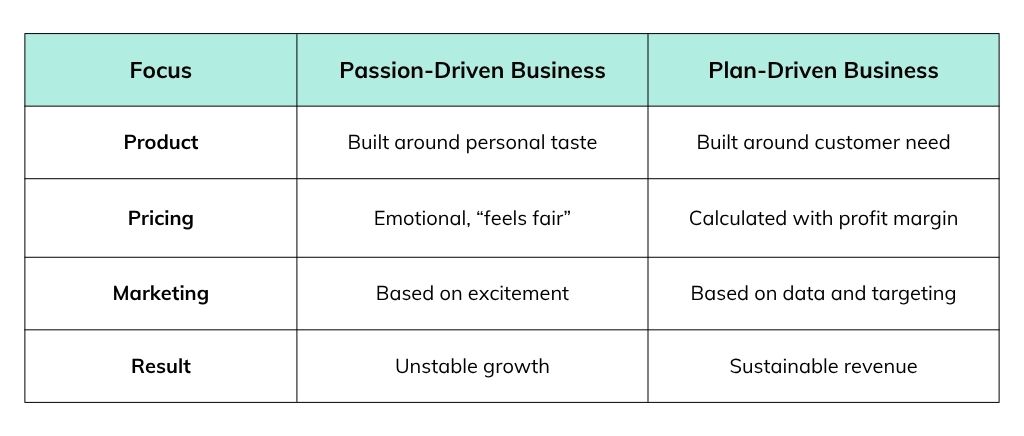
Without a plan, the business runs on feelings instead of facts.
People mistake effort for strategy. They spend months designing logos, perfecting packaging, and posting on social media, but never validate whether the product solves a problem.
Every failed business started with someone who cared deeply about something that didn’t sell.
“Passion Without Planning Is Expensive“
What Your Business Plan Actually Cares About
A real business plan doesn’t ask if you’re passionate. It asks if you’re prepared. Here’s what it actually wants to know:
1. Profitability
Can your idea make money, sustainably? What’s your profit margin after all costs, taxes, and fees?
2. Market Demand
Is there a consistent, paying audience for your product? Are you solving a real problem or just expressing yourself?
3. Scalability
Is the product/service scalable? Can you grow your business without destroying your finances or sanity?
4. Cash Flow
How much money do you need to survive each month? Is your product/service seasonal?
5. Competition
Who else is already doing it? Why would people choose you instead?
Your business plan is like a mirror. It reflects the truth, not your emotions.
. . .
Passion doesn’t need to disappear. It needs to be managed. It needs a framework. A business plan isn’t there to block emotion. It’s there to protect it from itself. Because when the plan is solid, passion finally has a place to grow, not burn out.